26 My field of study is to become a physiotherapist. terms
Hi, my name is Noémie. I have been studying in Natural Sciences for 2 years and in September I will study in University of Montreal. I create this glossary for people who want to become a physiotherapist like me.
My topic is about my field of study. The glossary will help people who study physiotherapy to learn and to understand several words relied on their study. Here will be thirty different terms describe and translate. I found these words on Wikipedia and I find their definitions on Google.
Appreciate and learn more! You will have an advance on everybody and it will be easier to understand what your teachers talk about.
dislocation
noun
The displacement of a bone out of a joint. Usually caused by trauma, there is normally damage to the ligaments, joint capsule and soft tissues.
Example: Common abnormalities, which include loss of extension and loss of flexion, may indicate old elbow injury, dislocation , fractures, etc.
fr: dislocation
electromyography
noun
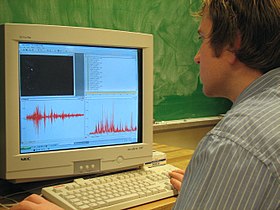
The recording of the electrical activity of muscle tissue, or its representation as a visual display or audible signal, using electrodes attached to the skin or inserted into the muscle.
Example: The technique of electromyography, the recording of electrical activity in active muscles, provided this link and remains an integral component of the contemporary functional morphologist's toolbox.
fr: électromyographie
electrotherapy
noun
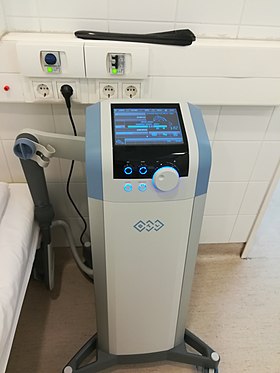
The use of electric currents passed through the body to stimulate nerves and muscles, chiefly in the treatment of various forms of paralysis.
Example: They were the first to use electrotherapy to cure pain, and also have an understanding of what happened.
fr: électrothérapie
exercise prescription
noun
Exercise prescription commonly refers to the specific plan of fitness-related activities that are designed for a specified purpose, which is often developed by a fitness or rehabilitation specialist for the client or patient. Due to the specific and unique needs and interests of the client/patient, the goal of exercise prescription should be focused on motivation and customization, thus making achieving goals more likely to become successful.
Example: Studies show that exercise prescription aids in both preventing and minimizing the effects of joint disorders such as osteoarthritis.
fr: prescription d'exercices
extensor
noun
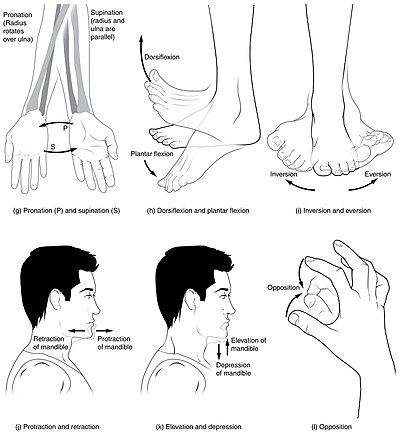
A muscle which causes an extension movement.
Example: Flexion force applied against long finger (third digit) extension distal to the proximal interphalangeal joint may provoke pain over the extensor muscle mass in the proximal forearm.
fr: extenseur
fibrocartilage
noun
A type of cartilage that is made of thick collagen bundles that are separated by narrow clefts. This tough cartilage is ideal as a 'spacer' or shock absorber in a joint. A fibrocartilage makes up the knee meniscus and the labrum tissue of the hip and shoulder.
Example: Fibrocartilage is primarily composed of type I collagen, and is located in areas like the intervertebral discs and the pubic symphysis.
fr: fibrocartilage
fine motor skills
noun
Motor skills refer to a person’s ability to perform co-ordinated movements using a combination of muscle actions. Gross Motor Skills tend to be performed by large muscles and they produce bigger body movements such as running and jumping. Fine Motor Skills tend to be initiated by smaller muscles such as those in the hand and they produce actions such as picking something up between the thumb and fingers or unscrewing the top from a bottle.
Example: Fine motor skills involve the use of the smaller muscle of the hands, commonly in activities like using pencils, scissors, construction with lego or duplo, doing up buttons and opening lunch boxes.
fr: dextérité
flexor
noun
A muscle that produces the movement of bending at a joint.
Example: The flexor muscles of our fingers are stronger than the extensor muscles.
fr: fléchisseur
gait abnormality
noun
Gait abnormality is a deviation from normal walking (gait). Watching a patient walk is the most important part of the neurological examination. Normal gaits require that many systems, including strength, sensation and coordination, function in an integrated fashion. Many common problems in the nervous system and musculoskeletal system will show up in the way a person walks.
Example: Research has shown that neurological gait abnormalities are associated with an increased risk of falls in older adults.
fr: anomalie de la marche
hydrotherapy
noun
Therapeutic exercises within the swimming pool.
Example: Cash will also go towards giving him all the medical care he needs such as speech therapy and hydrotherapy
fr: hydrothérapie
ice therapy
noun
The use of ice and ice water in the treatment of injury. Physiologically ice reduces metabolic activity within the tissues thus preventing secondary tissue damage; it also reduces pain signals to the central nervous system. Therapeutically ice therapy relieves pain and helps to reduce the development of swelling.
Example: Cold therapy is a technique where the body is exposed to extremely cold temperatures for several minutes.
fr: thérapie par la glace
interosseous membrane
noun
A band of ligament tissue, or band of fibrous tissue that connects two bones.
Example: The interosseous membrane's unique functional capabilities result from its anatomic and histologic organization, which produces a stiff structure with elastic properties capable of maintaining large loads.
fr: membrane interosseuse
joint mobilization
noun
Joint mobilization is a manual therapy intervention, a type of straight-lined, passive movement of a skeletal joint that addresses arthrokinematic joint motion (joint gliding) rather than osteokinematic joint motion. It is usually aimed at a 'target' synovial joint with the aim of achieving a therapeutic effect. These techniques are used by a variety of health care professionals with specific training in manual therapy assessment and treatment techniques.
Example: Joint mobilization is classified by the Australian physiotherapist Geoffrey Douglas Maitland into five 'grades' of motion, each of which describes the range of motion of the target joint during the procedure.
fr: mobilisation conjointe
kyphosis
noun
The medical term for the 'hunchbacked' posture. This is an increased curvature of the thoracic spine, which can be due to poor postural habits or pathological processes.
Example: In the majority of cases, kyphosis causes few problems and does not require treatment.
fr: cyphose
meniscus
noun
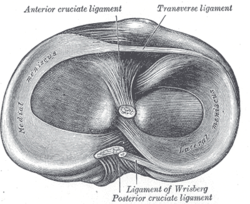
The semi circular shaped fibrocartilage 'spacer' within the knee joint. Its function is to act as a shock absorber and increase the congruency of the knee joint.
Example: The meniscus can be torn during activities that cause direct contact or pressure from a forced twist or rotation.
fr: ménisque
movement assessment
noun
Movement assessment is the practice of analysing movement performance during functional tasks to determine the kinematics of individual joints and their effect on the kinetic chain. Three-dimensional or two-dimensional analysis of the bio mechanics involved in sporting tasks can assist in prevention of injury and enhancing athletic performance. The identification abnormal movement mechanics provides physical therapists with the ability to prescribe more accurate corrective exercise programs to prevent injury and improve exercise rehabilitation and progression following injury and assist in determining readiness to return to sport.
Example: There are a variety of reasons for the utilization of a movement assessment, from improving communication and unity among your staff to improving your filter for complex movement.
fr: évaluation des mouvements
physical therapy
noun
Physical therapy (PT), also known as physiotherapy, is one of the allied health professions that, by using evidence-based kinesiology, electrotherapy, shockwave modality, exercise prescription, joint mobilization and health education, treats conditions such as chronic or acute pain, soft tissue injuries, cartilage damage, arthritis, gait disorders and physical impairments typically of musculoskeletal, cardiopulmonary, neurological and endocrinological origins. Physical therapy is used to improve a patient's physical functions through physical examination, diagnosis, prognosis, physical intervention, rehabilitation and patient education.
Example: The physical therapy is provided as a primary care treatment or alongside, or in conjunction with, other medical services.
fr: thérapie physique
prognosis
noun
The prospect of recovery as anticipated from the usual course of disease or peculiarities of the case
Example: Right now, doctors say his prognosis is good.
fr: pronostic
rehabilitation
noun
Restoration especially by the therapeutic means to an improved condition of physical function
Example: Rehabilitation is an essential component of universal health coverage along with promotion, prevention, treatment and palliation.
fr: réhabilitation
soft callus
noun
Loosley organised mass of woven bone that forms around a fracture site.
Example: When the soft callus is formed between the bone fragments, the stability of fracture fixation and stress shielding effect could still influence on loss of reduction or dislocation of bone fragments.
fr: callosités molles
soft tissue injury
noun
A soft tissue injury (STI) is the damage to muscles, ligaments and tendons throughout the body. Common soft tissue injuries usually occur from a sprain, strain, a one off blow resulting in a contusion or overuse of a particular part of the body. Soft tissue injuries can result in pain, swelling, bruising and loss of function.
Example: The R.I.C.E. method is an effective procedure used in the initial treatment of a soft tissue injury.
fr: lésion des tissus mous
sports medicine
noun
Sports medicine is a branch of medicine that deals with physical fitness and the treatment and prevention of injuries related to sports and exercise.
Example: Although most sports teams have employed team physicians for many years, it is only since the late 20th century that sports medicine has emerged as a distinct field of health care.
fr: médecine sportive
sprain
noun
A tear or partial tear of ligament tissue surrounding a joint, due to trauma such as a twist. A sprain may also affect other surrounding soft tissues surrounding the joint and can even be accompanied by bony injury.
Example: The difference between a sprain and a strain is that a sprain injures the bands of tissue that connect two bones together, while a strain involves an injury to a muscle or to the band of tissue that attaches a muscle to a bone.
fr: entorse
subluxation
noun
A partial dislocation of a joint.
Example: An example of a joint subluxation is a nursemaid's elbow, which is the subluxation of the head of the radius from the annular ligament.
fr: subluxation
tenosynovitis
noun
Inflammation of the sheath surrounding a tendon.
Example: Infectious tenosynovitis occurs between 2.5% - 9.4% of all hand infections.
fr: ténosynovite
valgus
noun
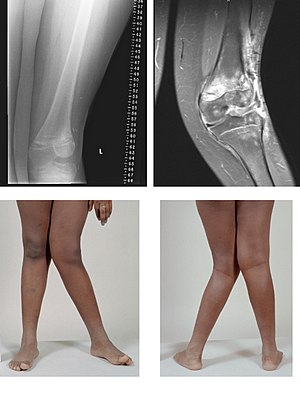
An anatomical description of a body part which is angled away from the mid line of the body. A Valgus knee position is commonly called the 'knock kneed' position.
Example: The lower extremities were equal in length, and no varus or valgus deformity of the knee was present.